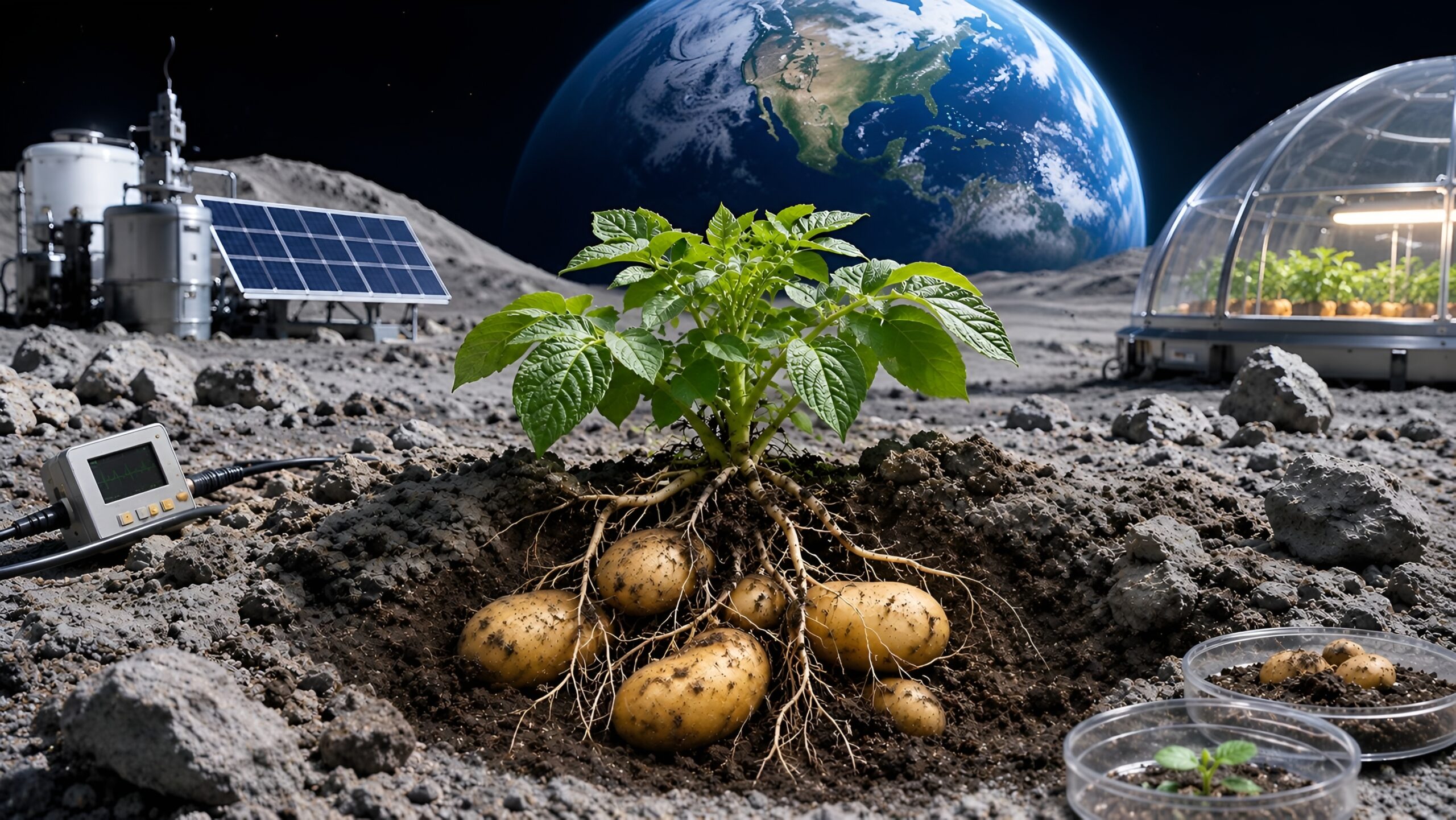
What would astronauts eat if they had to spend months or even years living on the Moon? Bringing food all the way from Earth might work for short missions, but it would become expensive and difficult over time.
One possible answer is to grow food right there. And scientists have now made some encouraging progress with a familiar vegetable: the potato.
Researchers at Oregon State University in the United States have successfully grown potatoes in soil designed to resemble material found on the Moon. With the right amount of compost, some of the plants grew just as well as potatoes planted in ordinary Earth soil.
The findings, published on November 19, 2026, in the scientific journal npj Microgravity, could help scientists develop ways to feed astronauts during future lunar missions.
Why Is Growing Food on the Moon So Difficult?
The Moon may have plenty of dust and rocks, but growing crops there is nothing like planting vegetables in a garden on Earth.
Much of its surface is covered with a loose layer of crushed rock and fine dust called lunar regolith. This material formed over billions of years, largely from meteorite impacts.
Unlike normal soil, lunar regolith contains almost no organic matter. It also lacks nitrogen, one of the nutrients plants need to grow.
There is another problem. Some of the minerals and metals found in lunar regolith can be harmful to plants, especially when present in large amounts.
Scientists would need to overcome these challenges before astronauts could start growing their own food on the Moon.
How Scientists Managed to Grow Potatoes in Moon-Like Soil
The research team, led by plant biologist Aymeric Goyer, used five different types of simulated lunar regolith for their experiments.
These materials were created on Earth to imitate the properties of soil-like material found in different regions of the Moon.
The researchers chose a potato variety called Modoc, which has red skin, white flesh and a relatively short growing period.
They then mixed the simulated lunar soil with different amounts of vermicompost, a natural soil amendment made when earthworms break down organic waste.
The plants also received additional fertilizer to provide essential nutrients.
The results showed just how important the compost was.
Potatoes grown in simulated lunar soil without compost struggled to develop. Their growth was severely limited, and their roots remained poorly developed.
Adding just 5% vermicompost helped the plants produce roots and small potatoes, although their growth was still weaker than in normal soil.
But when the compost level reached 30% in one of the simulated soils, the results were much better.
The potato plants grew and produced yields comparable to those grown in ordinary Earth soil under the same conditions.
For the scientists, this was an encouraging discovery.
The experiment was carried out in a greenhouse, where the temperature was kept at around 22°C during the day and 18°C at night. The plants received natural sunlight and artificial lighting.
Why Did Scientists Choose Potatoes?
There is a good reason the researchers chose potatoes instead of another vegetable.
Potatoes can produce a large amount of food in a relatively small growing area. That could be particularly useful on the Moon, where space inside a greenhouse would likely be limited.
They are also nutritious.
Potatoes contain vitamin C, potassium and protein. They can provide more potassium than bananas by weight and help people feel full for longer.
According to Goyer, potatoes produce more calories per unit of land than many other crops.
These qualities make them a promising option for astronauts who may need to grow food in limited spaces.
But Are These Moon-Grown Potatoes Safe to Eat?
The researchers have not tasted the potatoes they grew.
Instead, the harvested potatoes were sent for laboratory testing to examine their nutritional content and check for potentially harmful substances.
The early results were encouraging.
The researchers found that the potatoes had nutritional characteristics broadly similar to those grown in regular soil. They also found no significant increase in two naturally occurring potato toxins, solanine and chaconine.
However, some potatoes contained slightly higher levels of certain metals, including copper, zinc or aluminium.
More research will be needed to confirm their safety under different growing conditions.
The potatoes produced in this experiment were also quite small, partly because they were grown in small pots.
The team is continuing its research using larger containers and different potato varieties.
Could Astronauts Really Grow Potatoes on the Moon?
The experiment does not mean astronauts can immediately begin farming on the lunar surface.
These potatoes were grown on Earth, using artificial lunar soil inside a controlled greenhouse.
The researchers still need to understand how plants would respond to actual lunar soil, lower gravity, radiation and other difficult conditions on the Moon.
Still, the findings offer a possible way forward.
One idea is for future astronauts to bring a small amount of organic material from Earth and gradually produce more compost using leftover food and plant waste.
That could reduce the amount of growing material needed from Earth.
And potatoes are not the only crops being explored.
Scientists have also experimented with growing chickpeas in simulated lunar soil. Other researchers are studying crops such as tomatoes, lettuce and different types of legumes.
For now, growing a potato on the Moon remains a challenge. But this experiment shows that lunar-like soil can support crops when the right nutrients and organic materials are added.
If future research succeeds, astronauts living on the Moon may one day be able to harvest some of their own food instead of depending entirely on supplies sent from Earth.